
In the West's Shadow
For centuries, Eastern Europe was condemned to be a periphery whose fate was decided by outside powers. The question for the 21st century is whether that is finally changing.

When Count de Ségur, one of the French heroes of the American Revolutionary War, was passing from Prussia to Poland — and thus crossing the mythical border between Western and Eastern Europe in the minds of contemporary Enlightenment thinkers — on his way to St. Petersburg in the winter of 1784–85 to serve as French ambassador to the court of Catherine the Great, he remarked that he felt he had “left Europe entirely” and had “moved back ten centuries.” An American, John Ledyard, who had traveled around the world with Captain Cook, and in 1788 was returning from a solo expedition to Siberia which ended in his arrest by order of Catherine. Traveling west across the Russian empire, then through Poland, he did not consider himself to be back in Europe until he reached the Prussian border. There, between Poland and Prussia, Ledyard located “the great barrier of Asiatic & European manners,” and he “leapt” across with gushing enthusiasm: “Once more welcome Europe to my warmest embraces.”
Such observations can be found in the book Inventing Eastern Europe by Larry Wolff, published in 1994. Wolff argues that Eastern Europe is not a geographical fact but an intellectual invention — created by Western European Enlightenment thinkers in the 18th century. Before the Enlightenment, Europe’s defining division in the minds of many often ran north to south, with civilised Italy contrasted against the barbaric north. The Enlightenment redrew that line east to west. Travellers, philosophers, and cartographers did not simply describe Eastern Europe, but actively constructed the concept. From the sixteenth century onwards, Eastern Europe had become the economic periphery of the West, supplying grain cultivated by serf labour. The traveller Marshall compared Polish serfs directly to African slaves in the Caribbean — describing conditions of “such a despotism as the planters in the West Indies use over their African slaves.” Each travel account added another layer to an image that eventually came to seem self-evident. Wolff traces how specific clichés — dirty hovels, serfs, savage manners, Oriental elements — were reproduced from traveller to traveller, because each arrived carrying the mental map of his predecessors. Eastern Europe was constructed as an in-between space — between Europe and Asia, between civilisation and barbarism, between the present and the past. Wolff calls this “demi-Orientalization.” Edward Said, in the (in)famous Orientalism, argued that the West constructed the Orient as its mirror opposite. Wolff argues the same happened with Eastern Europe, but with a crucial difference: Eastern Europe was simultaneously included in Europe and excluded from it — a place to be reformed and uplifted. The French expression l’orient de l’Europe was ambiguous from the outset — meaning simultaneously “the east of Europe” and “the Orient of Europe.”
I had always had a very ambivalent relationship with this idea. Now, of course, it contains a lot of truth — it is a fact that when a certain idea of Eastern Europe, an idea that is self-flattering to people from Western Europe, becomes common among the thinkers and travelers of those times, those preconceptions can then influence how these people view the region when they enter it. Selection bias might get to work and one can suddenly see more things that confirm his already previously existing views on the region. Fair enough. Yet I have always resented the — for lack of a better word — “third-world” nature of that book’s thesis, as can also be seen in the aforementioned parallels deliberately drawn by the author to Orientalism, one of the founding texts of the entire post-colonial studies universe.
The reality is that even if one forgets all the ideological superstructure, all the conscious and unconscious molding of our views by “the discourse,” and all the power that words have in forming our worldview and actions, in the end there exist concrete things that you can “touch” and that simply matter. Some societies exist at a higher level of techno-economic development than others. It is measurable and real. Somewhere you can drink tap water and somewhere you will get such brutal diarrhea that you might spend most of your precious all-inclusive vacation on the toilet — and when you come back your friends might ask whether you had been to Hurghada or to Dachau. Somewhere electricity runs 24 hours a day, 7 days a week, and somewhere you must plan to charge your phone — so you can go on X and share memes about your country being the next great superpower — during the hours when electricity is actually available. Somewhere 100 children out of every 1,000 born die before reaching the age of one, and somewhere it is 1.5 children out of 1,000. And on average, even with all the nuance that the subjects of human flourishing and material conditions deserve, life is simply better in those places at a higher level of development than in those at a lower one.
Sure, Westerners did construct an idea of the Orient that was at least partially shaped by their biases — biases that served as the opposite of their perhaps self-congratulatory self-image. But the reality is that the technological disparity between Western colonial powers and the colonised “oriental” lands was so massive that some of those “prejudices” were simply correct. The proof is in the pudding: if one society is able to completely dominate another while deploying only a relatively tiny amount of manpower — owing to its superior application of the scientific method and thus its next-level weaponry — then it can be said that that society objectively is more rational and dynamic. And the truth simply is that Eastern Europe — the precise delimitation of which may be open to debate — was measurably far more backward than Western Europe. Serfs throughout Eastern Europe truly were treated in a cruel and slave-like manner — scourged, sold like cattle, without any dignity or rights. In 1750, 85% of Dutch people over the age of 14 were able to read, while only 5% of Poles could. Statistics such as these were probably a bigger reason for the “invention” of Eastern Europe than any desire on the part of 18th-century Frenchmen — stuck-up as they without any possible doubt were — to place themselves in a higher civilisational position. If several travellers described the border between Poland and Prussia as being of real significance, then perhaps — it just was. Maybe the poetic description of “moving back ten centuries” is a little overblown, but it certainly captures something real. Try to make your roads fit to be driven on, your water and electricity reliably running around the clock, and your shop shelves reliably stocked with basic goods before getting too worked up about “discourse” interpretations of your region, so to speak.
The Pupils
What I have always appreciated about Eastern European nations — at least that group which managed to get into NATO and the EU and has been experiencing economic ascension — after the end of the Cold War was their ability to not bullshit themselves. There was a clear-eyed acknowledgment of the fact that their countries had simply and completely failed in competition with the West. No one was any longer able to pretend otherwise; you only needed to spend a short time on each side of the Cold War border to lose any illusions whatsoever. Everyone was tired of the charade — the performance the regimes kept up unconvincingly — of pretending that the capitalist West would any moment now be definitively surpassed by objectively superior scientific communism. Now, this psychological ability to admit “defeat” was made easier by the fact that the region was emerging from a period of communism, which was in vast majority of cases imposed from outside, and much of the backwardness of the region could be neatly “outsourced” onto communism. But beneath the important and often horrific — yet still relatively superficial, with the exception of the Soviet core — crust of communist influence lay several centuries of cumulated socioeconomic lagging behind the West.
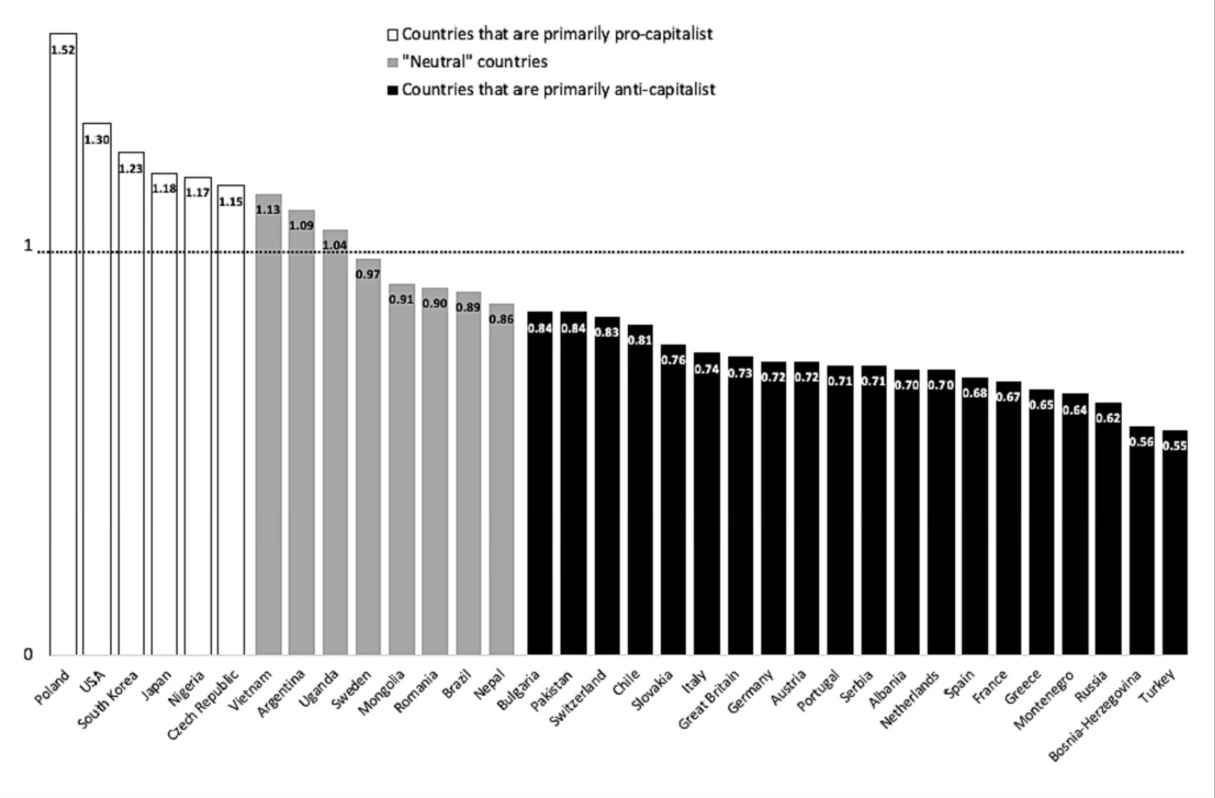
After 1989, the countries of the region essentially came to the doorstep of the Western powers, whether the US or Western European states, and said: “We humbly come to learn from you. Your ways are clearly superior and we will study them like pupils.” And it worked — economically, the region is simply one of the great success stories of the past three decades. One of the interesting legacies of this is that, due to economic neoliberalism being the most potent ideological force in the West at the time, the region’s populations remain to this day considerably more fond of free-market capitalism than is the norm anywhere in Western Europe. There is a study from 2023 examining attitudes towards capitalism across 34 countries. In only six of them was capitalism viewed more positively than negatively — Poland, the USA, South Korea, Japan, Nigeria and the Czech Republic. There is also basically no version of the “let’s fix all social problems by taxing billionaires into oblivion” type of left present in the region.
But make no mistake, the process was psychologically quite humiliating and not without serious costs. Eastern Europeans had harboured an inferiority complex towards Western Europeans for a long time before the communist period. The pattern of a semi-colonial periphery economically supplying mostly raw materials and agricultural products to industrialised Western Europe — while the children of the narrow regional bourgeoisie studied in Paris, London or Berlin — was well established from at least the 17th century. After the fall of communism, this inferiority complex was only significantly reinforced, as the paternalistic nature of the relationship between Western and Eastern Europe became probably more formalised than it had ever been. For Western Europeans, post-communist Europe became a sort of last space onto which their “civilising colonialist” ambitions could be projected — a part of the world not protected by any of the modernist “taboos” that shield much of the third world from the obnoxious lecturing of Westerners.
As the Bulgarian author Ivan Krastev beautifully described in his book The Light That Failed, the region underwent a process of being essentially dictated to — told how to structure its economic, political, legal and even social orders by Western states — and the most desirable outcome on offer was nevertheless still an imperfect imitation of something you are not. This created a great deal of resentment, and still does. In every post-communist country there is a sizeable and media-friendly class of people for whom the only relevant point of reference when it comes to organising society — politically, economically, socially or culturally — is simply “the West,” an idea often shaped by obsolete memories of an Erasmus semester spent in Berlin or Copenhagen in 2005, reinforcing their notion of what a good society looks like. A neat paradox is the fact that the region that most acutely suffered from the resentment born out of humiliation is not Poland, Hungary or Romania. It is East Germany — the old Prussia which was precisely where European civilisation finally reappeared, in the eyes of those very travellers arriving from the timeless barbaric steppes of the east. Since East Germany was incorporated into the much larger, wealthier and more powerful West German state, it was developed economically through the massive sums of money invested there by the Bundesrepublik — but its sense of self and ability to determine its own fate were almost completely lost. The inhabitants of East Germany were asked no questions; they were simply expected to listen to what their enlightened Western counterparts had to say. If your wife constantly reminds you that your neighbour earns more money, drives a newer car, has a nicer house and has lost weight, you might start to resent the fellow a little. But at the beginning, there was an acknowledgment of the hard cold facts, and it was used as motivation to improve. Eastern Europeans responded to this “wife-nagging” by taking on extra shifts at work and going to the gym. Perhaps we will never get quite as nice a car as the neighbour — but we might get a somewhat nicer one. That is the productive way to react.
That is also why I never really went in for the whole “we are Central Europe, not Eastern Europe” schtick — and that is even so coming from a country which, together with East Germany, probably possesses the most legitimate Central European claim of all post-communist countries, and one that was damaged by communism the most in terms of its economic prospects. Czechoslovakia — and specifically its Czech half — was economically and educationally more or less on par with Western European countries before the Second World War, and the period of communist rule meant a clear decline from that position. In basically all the other Eastern Bloc states, communism — while the social and cultural costs were absolutely horrific, and while it is a system that eventually and inevitably leads to economic degradation — did at least succeed in transforming predominantly agrarian, pre-modern economies into industrial ones with a much higher level of education among the population, especially in technical fields. Yet I have always disliked the validation-seeking nature of the “Central European” obsession. When speaking in Czech about my country or the region, I use the term Central Europe, but I do not engage in persuading others. In the minds of the vast majority of people throughout the West, as well as throughout the wider world, every post-communist country is Eastern Europe — and the reality is that there is also an ethnic element to it, with the West being, among other things, defined by its Germanic and Latin linguistic heritage. There is no point in endlessly trying to persuade everyone to redraw their inner mental maps. Let us work hard to make our countries better, and in due time those mental maps will adjust on their own.
And they are being adjusted, although often slowly. There is still a surprising number of people for whom anything beyond the former Iron Curtain still means basically the Eastern Europe scene from Eurotrip. You can still hear about people from Western Europe being told by their parents “to be careful out there” when traveling to some post-communist EU country — almost invariably now a safer one than the country the visitor is from. You can still hear stories about senior managers from Western European-based corporations coming here for a business visit to the local subsidiary, acting as one would imagine a French administrateur colonial arriving in the Maghreb in the 19th century to perform some mission civilisatrice. For some reason, these sorts of stories disproportionately and overwhelmingly involved French people specifically. When my wife was in France on an exchange trip in high school — maybe thirteen years ago — she was genuinely asked whether they had running water and electricity in Slovakia by the teenage children of the family she was staying with, and the teacher at the high school she visited was completely clueless as to where Slovakia is on the map of Europe. Now, I am all for mercilessly making fun of Slovakia as simply the mountainous part of northern Hungary where they have not yet brought in electricity — that is simply good manners for every Czech person. Yet it is mostly funny because we know it is not really true, and Slovaks get really fired up getting shit from Czechs. But it is quite shocking that people in France might think it actually is true. And I would of course not be surprised in the slightest if some American auto mechanic in Nebraska had no real idea where Slovakia is on a map — let us be honest, why would he care. Europeans would not be able to find Nebraska on a blank map either. But for a teacher in France — meaning a university-educated European — it is fairly remarkable.
The Reflection Talks Back
But the change is taking place — the last decade can be seen as a period of significant emancipation and rising confidence of the region’s nations. Several factors have led to this development. First of all, the countries of the region simply got much wealthier. The days of Czech tourists visiting Vienna by bus, having packed their schnitzels with bread from home because a restaurant lunch in Vienna could cost a fifth of their monthly salary in the early 1990s, are long gone — Czech tourists are now among the most frequent visitors to the Austrian Alps, where hundreds of thousands go skiing every year. After the war in Ukraine started, a large wave of investment into Spanish real estate from Czech, Polish and Slovak upper-middle classes worried about the war spreading westwards took place — something unthinkable just a few decades ago. The cumulative economic growth of the region has reached a point where the combined nominal GDP of the post-communist EU countries stands at around 3 trillion dollars — larger than that of Italy, Russia or Brazil. Taken together, it would constitute the 8th largest economy in the world. In terms of PPP, the cumulative GDP of the region is now 5.4 trillion dollars, which would place it above the GDP of France or the UK. Of course, in terms of per capita figures, especially in nominal terms, the gap with the wealthy Western European countries is still considerable and is unlikely to ever be fully bridged. Yet even there we can find considerable success — in terms of nominal GDP per capita, which is the harsher metric, countries like Czechia, Estonia or Slovenia have surpassed Japan or South Korea, which is no small achievement. Poland will probably get there within a few years. In terms of GDP per capita at PPP, Poland has surpassed New Zealand, which is quite something. But that is not really the point — the point is that the region simply is no longer an economic afterthought, but one of Europe’s centres of gravity. It does not have to be the most important one, but at least it has earned a seat at the table.
The second very important piece of the puzzle is the Russian invasion of Ukraine and the proverbial return of geopolitics to Europe. The impacts of this event are not equally shared across the region and are concentrated mostly in the northeastern, Baltic-adjacent part of Eastern Europe, where the threat from Russia is felt most intensely. It has led to the massive and ongoing military build-up of Poland, which now spends almost 5% of GDP on defence — the highest proportion in the whole of NATO and the 7th largest among the 40 countries with the highest military expenditures in the world. It has broadened the strategic cooperation of Poland and the Baltic states with the Nordic countries located on the shores of the Baltic Sea, and has also given new impetus to initiatives — mostly Poland-initiated and led — such as the Three Seas Initiative, aiming at more thorough vertical, north-to-south infrastructural interconnections of the region, such as the planned Via Carpathia, a highway connecting the Lithuanian port of Klaipėda with Thessaloniki in Greece, or pipelines connecting LNG terminals in Poland and Croatia. The recent summit of the initiative in Dubrovnik, Croatia, was attended, among others, by Ukrainian Prime Minister Svyrydenko, US Energy Secretary Chris Wright, Turkish Foreign Minister Hakan Fidan, and an enormous Japanese delegation of 60 companies.
But I would say that the most important contribution of the invasion — if such a word can be used at all to describe so horrific an event — is that it provided a number of states in the region with a stark reminder of what the essential purpose of the state actually is. The fundamental purpose of a state is the protection of its inhabitants from physical harm and conquest by outside actors. It comes before any other possible purpose or function, such as material wellbeing, the flourishing of national culture, the protection of the natural rights of citizens, or some of the more luxurious modern preoccupations such as social justice or solving the climate crisis. Polls consistently show that one of the best predictors of willingness to fight for one’s homeland is precisely the presence of concrete danger. This might seem quite counterintuitive — one would think that people in entirely safe countries would be most lavish with their declarations of willingness to fight, precisely because it is not about to actually happen. But countries closer to the Russian threat — Finland, Sweden, the Baltic states, Poland or Romania — consistently rank highest in their willingness to defend themselves. Pacifism is a privilege of those far from the actual heat. A recent Substack post from Silicon Continent showed that the closer a country in Europe is to Moscow, the higher are, on average, its defence, education and investment spending. Danger tends to sharpen the sense of what matters. One of the reasons for the Western European malaise of the past couple of decades is, I believe, simply the fact that since the end of the Cold War and the diminishing of the Soviet threat, the region has been so removed from any real dangers that it has struggled with a sense of purpose. If material conditions are overall entirely comfortable, no military threat is on the horizon, and you are no longer a world power managing a global empire — as the US still is — what guiding principles should lead one’s actions? Even determining what constitutes the national interest can be quite complicated without the urgency provided by an external threat.
Last but not the least, there is the issue of immigration. Mass asylum immigration — specifically from the Middle East and North Africa — represents the most significant case of the eastern half of the continent being very firmly convinced that something being pushed onto them by, broadly speaking, the Western half was a really, really stupid thing to do, and then being proven completely correct in that assessment over the course of roughly a decade. The symbolic psychological significance of this is greater than the practical impacts on daily life in the respective countries. It represents the decisive moment when the proverbial bubble of Western infallibility definitively burst in the minds of many of the region’s inhabitants. The rhetoric of the region’s Zapadniki — urging emulation of the West in all things — simply never sounded quite as persuasive again after that. While there was a fair share of people in the post-communist countries urging emulation of Western Europe’s accepting approach towards refugees — often visibly ashamed of their own nations and their perceived moral immaturity relative to the West — popular opinion was so overwhelming that the subject became politically untouchable. No one could even suggest it. Moreover, if the elites of mighty Western countries such as Germany — always the epitome of a well-oiled, functioning state and society in the minds of post-communist Europe — or Sweden could be so completely wrong about something so painfully obvious to your average Czech dad working as an electrician in a small town, what else might they be wrong about? Is the vision of leading the humanitarian battle against climate change by heavily undermining cheap energy production and thus industrial competitiveness really wise? Is the European model of the “regulatory superpower” really the way to go in the 21st century? I will leave the answer to the reader. The biggest problem of Western Europe — and I am using this term as a generalisation that glosses over substantial differences between individual countries — is, in my opinion, the implicit belief that the wealth, safety and orderliness of the region are simply given, almost as a fact of nature, and will not erode even if their foundations are constantly undermined. Wealth is mostly to be redistributed rather than created; politics must engage with the various ways of making society more just and equal across the board, rather than with the maintenance of the basic pillars of prosperity, security and order. If one does not tread carefully and cherish the foundations of Europe’s prosperity, it can all slowly wither away in time. Eastern Europeans understand the fragility of it all more deeply.
One must not become too euphoric about this, however. If one takes this too far and simply inverts the logic — instead of seeing everything from the West as inherently good, seeing it as inherently bad — one will get even worse results, and this must be rejected. The success of Eastern Europe stems precisely from successful integration with the West. The history of countries such as Ukraine, Belarus or Moldova clearly showcase that the alternative is far worse. There are people — sometimes natives of the region, very often not — who tend to euphorically declare that the region is the future of the European continent, in juxtaposition with a terminally declining Western Europe. That is delusional, and it is merely an inverted version of the negative stereotypes described by Larry Wolff, where people tend to project their own ideological preferences onto the region. Eastern Europe is not some based paradise. Despite getting richer, the region is still comparatively much poorer, lacks homegrown large corporate multinationals, is demographically declining, accounts for less than a quarter of the EU population, and is politically fragmented into a number of mostly mid-sized and very small states with often contradictory interests and outlooks. While this is often exaggerated, it is true that the cohesion funds paid by the EU’s wealthier member states played a relevant role in the region’s economic ascension. The ideas entertained by many about Europe being divided into a prosperous and ethnically homogeneous eastern part and a chaotic western part being pulled into the abyss by ethnic strife and Islamisation are mostly the preserve of chronically online types — and often reflect a certain psychological schadenfreude on the part of people from the European East who, long having suffered from an inferiority complex towards Western Europe, derive some satisfaction from seeing it grapple with serious troubles of its own. The initial pragmatism of the post-communist period — correctly assessing what works and sticking to that game plan — must be preserved, rather than giving way to triumphalist celebration of one’s own successes.
The French philosopher Chantal Delsol wrote in her 2003 book that she saw the biggest difference between Western and Eastern Europe in the fact that Eastern Europeans had still somewhat retained a sense of the tragic dimension of life that had been erased in the West. I think it is a rather apt description. The Eastern European approach towards the outside world is simply, intuitively, far more defensive and distrustful. It is less optimistic, less idealistic, more cynical. There are times when that can be a disadvantage, and times when it can be an asset. Throughout the modern period, Eastern Europe has been characterised by being a continuously peripheral area moulded more by outside powers than by its own agenda. This is also the reason why I do not include Russia in the region — even though geographically, ethnolinguistically and in many ways culturally it of course belongs there. Russia has been an imperial power throughout the modern period, and this makes its outlook fundamentally different. The goal for the 21st century should be to avoid this fate — to finally sit at the table and look the other European powers in the eye — whether Germany, France or even Russia — as equals whose voice is to be heard rather than merely receiving the wisdom of more advanced or powerful nations. Never in modern history have the cards been dealt so favourably for the region. All the great European imperial powers of the past — the UK, France, but from the perspective of Eastern Europe especially Germany and Russia — are in more or less pronounced stagnation or decline, unable to truly assert their dominance over the region. The countries of the region are no longer weakened by the continuous bickering and petty conflicts among themselves that so defined the interwar period. The opportunity is there; now it only remains to seize it. So far, it is looking quite promising.
Incredible summary, yes indeed it seems like in the 21st century Eastern Europe is better ready and more realistic about the challenges. Their only problem remains demography and brain drain but they have been reversing that, and the situation is much less worse than the Balkans.
When I read Orientalism, I was surprised at how Said gives example after example of strange and occasionally repulsive behavior described by European visitors to the Middle East, and then he claims that "we" used it to keep "them" oppressed.
Why not just assume that descriptions of other cultures and people is precisely that? That's how travel descriptions have always been.
My guess is that it's the same with Eastern Europe. Rather than dismiss those descriptions, we should read them and assume they describe the actual culture of those places at the time.